S&P500 Trading Update 7/4/26

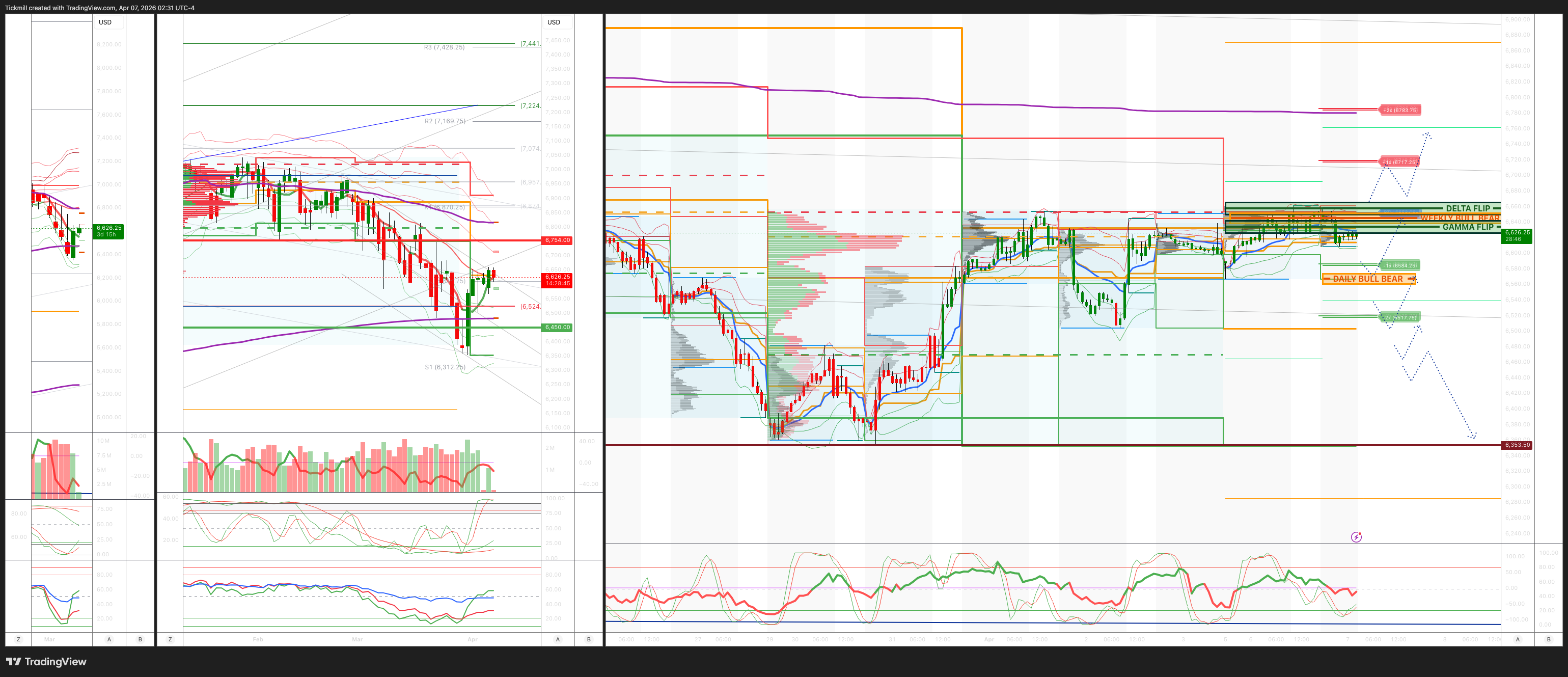
S&P500 Trading Update 7/4/26
***QUOTING ES1! FOR CASH US500 EQUIVALENT LEVELS, SUBTRACT POINT DIFFERENCE***
WEEKLY BULL BEAR ZONE 6640/50
WEEKLY RANGE RES 6754 SUP 6450
April OPEX Straddle: 328.55pt range implies a OPEX to OPEX range of [6177, 6835]
June QOPEX Straddle is 546.4pt giving us a range of [5960,7052]
JHEQX Q2 Collar 6189/6290 - 6865/6955
DEC2025 OPEX to DEC2026 OPEX is 945 points giving us a range of [5889,7779]
PUT/CALL RATIO 1.26 (The numbers reflect options traded during the current session. A put-call ratio below 0.7 is generally considered bullish, and a put-call ratio above 1.0 is generally considered bearish)
DAILY VWAP BULLISH 6608
WEEKLY VWAP BULLISH 6591
MONTHLY VWAP BEARISH 6816
DAILY STRUCTURE – OTFH - 6598
WEEKLY STRUCTURE – BALANCE
MONTHLY STRUCTURE - OTFD - 6911
Balance: This refers to a market condition where prices move within a defined range, reflecting uncertainty as participants await further market-generated information. Our approach to balance includes favouring fade trades at the range extremes (highs/lows) while preparing for potential breakout scenarios if the balance shifts.
One-Time Framing Higher (OTFH): This represents a market trend where each successive bar forms a higher low, signalling a strong and consistent upward movement.
One-Time Framing Down (OTFD): This describes a market trend where each successive bar forms a lower high, indicating a pronounced and steady downward movement.
DAILY BULL BEAR ZONE 6570/60
GAMMA FLIP 6635
DAILY RANGE RES 6717 SUP 6584
2 SIGMA RES 6783 SUP 6517
VIX BULL BEAR ZONE 22
TRADES & TARGETS
LONG ON REJECT/RECLAIM OF DAILY BULL BEAR ZONE TARGET DAILY RANGE RES
***ADDITONAL SETUPS & TARGETS HIGHLIGHTED ON THE CHARTS***
(I FADE TESTS OF 2 SIGMA LEVELS ESPECIALLY INTO THE FINAL HOUR OF THE NY CASH SESSION AS 90% OF THE TIME WHEN TESTED THE MARKET WILL CLOSE ABOVE OR BELOW THESE LEVELS)
GOLDMAN SACHS TRADING DESK VIEW - ‘Muted’
NDX +61bps @ 24,192, R2K +42bps @ 2,541, Dow +36bps @ 46,670, and S&P +44bps closing @ 6,612 with a MOC of $1.8bn to BUY. 14.75b shares traded across all US equity exchanges compared to the daily average of 19.5b shares yesterday. VIX +155bps @ 24.24, WTI Crude +82bps @ $112.45, US 10YR unch @ 4.33%, gold -50bps @ 4,653, dxy -4bps @ 99.99, and Bitcoin +306bps @ $69,713.
As investors continue to wait for the Middle East war to end (the latest Iran deadline is tomorrow at 8 p.m. ET), today was the slowest US stock volume session of the year (14.8 billion shares and $663 billion notional changed hands today, both of which are new YTD lows). This afternoon's Trump press conference was unimpressive. With trading volumes tracking -30% versus. 20d avg, it was extremely quiet. ETF notional volumes are likewise low, running at 35% of the tape (slightly above the ytd average of 34%) and tracking -40% compared to the 20d average. Thematically, GS's "tax refund beneficiaries" basket is the second-strongest basket (just after bitcoin-sensitive "memes" #3). This was a well-liked trade at the beginning of the year, but more recently, it was believed that increased oil prices had largely offset the gain.
On a scale of 1 to 10, the overall level of activity on our floor was a 2. Compared to a 30-day average of -63bps, our floor concluded +319bps to purchase. Out-of-office responses were high and single stock activity was subdued. Due to supply in the tech and industrial sectors, LOs ended up being modest net sellers. Due to sporadic cover demand in Hcare and increased M&A in the industry, HFs completed about 800 million net buyers. Following the announcement that NBIX would buy the company for $53 cash per share, SLNO saw a +32% increase (19% short interest). Since the beginning of the year, there has been roughly $20 billion in biotech M&A of public assets, according to our tally. This suggests that the consolidation topic will continue to receive attention.
We will be watching FOMC minutes on Wednesday, PCE on Thursday, and CPI on Friday this week. DAL reports on Wednesday morning, while LEVI reports on Tuesday night. By the end of the week, we anticipate a blackout of approximately 95% and 97% for corporates. During the blackout window, we usually expect our flows to drop by about 30%.
Next week, large-cap banks will begin reporting earnings: Priorities for the 1Q26 EPS season include: 1) the NII projection; 2) the threats to capital markets revenue posed by the increase in market volatility; 3) the effects of rising energy prices on credit quality and provisions; and 4) the ways in which banks will make use of the greater flexibility in their balance sheets resulting from reduced capital requirements.Despite producing good ROTCEs even when accounting for the recent macro uncertainties, we find the group's valuation more in line with historical norms following a largely multiple-driven 7% YTD sell off. We continue to believe that BAC, C, and WFC are the most topical and well-positioned equities. (Preview of 1Q26)
Disclaimer: The material provided is for information purposes only and should not be considered as investment advice. The views, information, or opinions expressed in the text belong solely to the author, and not to the author’s employer, organization, committee or other group or individual or company.
Past performance is not indicative of future results.
High Risk Warning: CFDs are complex instruments and come with a high risk of losing money rapidly due to leverage. 68% and 74% of retail investor accounts lose money when trading CFDs with Tickmill UK Ltd and Tickmill Europe Ltd respectively. You should consider whether you understand how CFDs work and whether you can afford to take the high risk of losing your money.
Futures and Options: Trading futures and options on margin carries a high degree of risk and may result in losses exceeding your initial investment. These products are not suitable for all investors. Ensure you fully understand the risks and take appropriate care to manage your risk.
Patrick has been involved in the financial markets for well over a decade as a self-educated professional trader and money manager. Flitting between the roles of market commentator, analyst and mentor, Patrick has improved the technical skills and psychological stance of literally hundreds of traders – coaching them to become savvy market operators!